
Introduction
For those new to the world of Chinese tea, the variety of names can be confusing: Is Anji “White Tea” actually a white tea? Is Da Hong Pao a black tea? How exactly are Chinese teas classified, and what is the logic behind the system?
In fact, Chinese tea classification is not based on the tea plant cultivar or commercial name, but on its core processing techniques, particularly the degree and method of fermentation (oxidation). This rigorous classification criteria forms the scientific foundation of the Chinese tea system, where different processing pathways create a vast spectrum of colors, aromas, and flavors. This article systematically explains this classification framework to provide a clear entry point.
I. The Core Logic of Classification
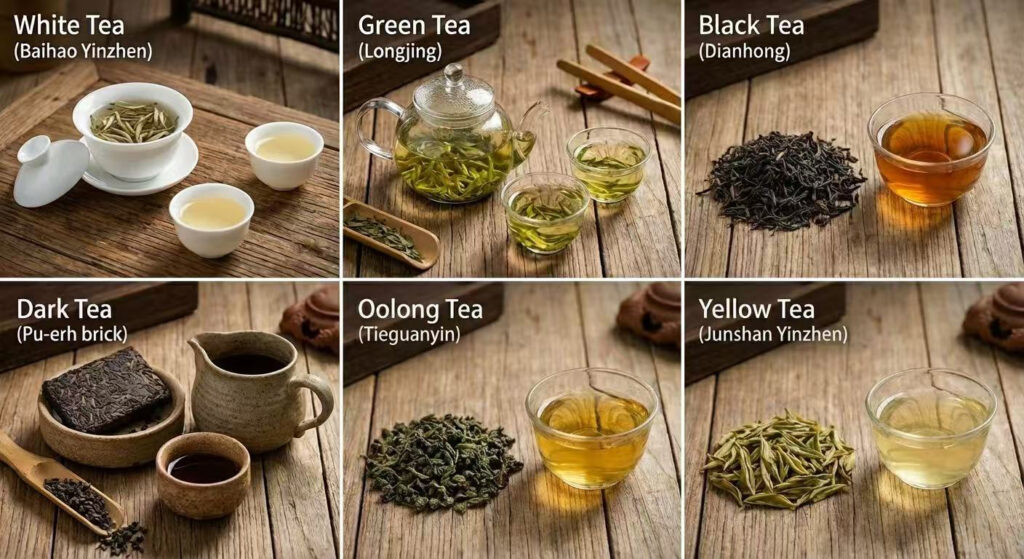
Following industry consensus, Chinese tea is scientifically divided into the “Six Basic Tea Categories” based on their core manufacturing processes: Green Tea, White Tea, Yellow Tea, Qing Tea (Oolong Tea), Black Tea, and Dark Tea. The key to this classification criteria lies in distinguishing the fundamental differences in how the core transformation process of “fermentation” is applied or controlled in each technique.
Two important concepts must be clarified: First, the six categories represent the basic classification based on primary processing. Products that undergo secondary processing (e.g., scenting, pressing) using these basic teas as raw materials, such as Jasmine Tea or Pu-erh tea cakes, are termed “reprocessed teas,” constituting a secondary classification based on product form. Second, Qing Cha is more commonly known among consumers as “Oolong Tea.” Its name derives from the dark greenish-brown (“qing”) color of its dried leaves, serving as the umbrella term for semi-oxidized teas.
II. Detailed Analysis of the Six Basic Tea Categories
1. Green Tea — The Fresh Taste of Spring
Green Tea is a non-fermented tea. Its core process is Fixation (Shaqing/Kill-Green) — using high heat to rapidly deactivate enzymes and halt oxidation. This allows Green Tea to retain a maximum of its fresh, natural compounds, resulting in the classic profile of “clear liquor and green leaves.” Its aroma is delicate and elegant, often with notes of beans or chestnuts, and its taste is refreshingly brisk with a sweet aftertaste. Famous examples include West Lake Longjing and Biluochun. It is important to note that Anji “White Tea,” despite its name, belongs to the Green Tea category due to its fixation processing.
2. White Tea — The Essence of Minimalism
White Tea is a minimally fermented tea, renowned for its simplest processing which involves only Withering and drying. The leaves lose moisture slowly under natural conditions, undergoing slight oxidation to a degree of approximately 5-10%. This process gives White Tea its characteristic appearance of “leaves covered with silvery-white hairs (Hao) and a pale liquor,” along with a uniquely sweet, mellow flavor and a noticeable “Hao Xiang” (fragrance of the fine hairs). Baihao Yinzhen (Silver Needle) and Baimudan (White Peony) are premier examples, celebrated in the saying, “One year is tea, three years medicine, seven years treasure.”
3. Yellow Tea — The Subtle Art of ‘Men Huang’
Yellow Tea is a lightly fermented tea. Its processing is similar to Green Tea but includes a unique crucial step called Piling for Yellowing (Men Huang). Under warm and humid conditions, the tea undergoes light fermentation (approx. 10-20%), developing its signature “yellow leaves and yellow liquor.” Yellow Tea has a clean, pleasant aroma. Its taste is mellower and smoother than Green Tea, with reduced astringency. Junshan Yinzhen and Huoshan Yellow Bud are renowned varieties.
4. Qing Tea (Oolong Tea) — The Kingdom of Aroma
Qing Tea, commonly known as Oolong Tea, is a semi-fermented (semi-oxidized) tea with a remarkably wide oxidation range (15-70%). The core of its processing is Zuo Qing (Making Green), an alternating sequence of shaking and withering that bruises the leaf edges, promoting their oxidation while the center remains green. This creates the distinctive “green leaves with a red rim.” Oolong Tea combines the fresh fragrance of green tea with the depth of black tea, celebrated for its incredibly complex, floral aromas and rich, lingering taste. From the floral, refreshing Anxi Tieguanyin to the robust, mineral Wuyi Rock Tea (e.g., Da Hong Pao), and the intensely fragrant Fenghuang Dancong, Oolong Tea offers a wonderfully diverse world.
5. Black Tea — The Fully Oxidized, Mellow Cup
In processing terms, Black Tea is a fully oxidized tea (technically enzymatic oxidation, though traditionally termed ‘fermentation’ in the tea trade).” or more accurately. The key step involves rolling to disrupt leaf cells, enabling enzymatic oxidation where tea polyphenols are largely converted into theaflavins and thearubigins. This results in the classic profile of “red liquor and red leaves,” characterized by a sweet, full-bodied taste with aromas ranging from honey and sweet potato to floral or fruity notes. Lapsang Souchong is considered the ancestor of all black teas, Keemun Black Tea is famed as the “Queen of Fragrance,” and Yunnan Dianhong is known for its bold, robust character.
6. Dark Tea (Hei Cha) — Tea Transformed by Time
Dark Tea is a post-fermented tea. Its uniqueness lies in the Pile Fermentation (Wo Dui) process. Driven by microbial activity, the tea undergoes profound transformation—a process that continues over time, granting Dark Tea its prized characteristic of “improving with age.” The dry leaves are dark brown, the liquor is deep red or dark amber, and the taste is profoundly mellow, smooth, and often carries unique notes of aged wood, earth, or medicinal herbs. Yunnan Ripe Pu-erh, Hunan Anhua Dark Tea, and Guangxi Liubao Tea are all quintessential representatives of this category.
III. How to Choose and Appreciate?
Understanding the classification provides a clear map for exploration:
- Observe the Color: From the vibrant green of Green Tea, the silvery-white of White Tea, the golden yellow of Yellow Tea, the dark green-brown of Oolong, the black-red of Black Tea, to the deep brown of Dark Tea—color is the most direct indicator of processing.
- Explore the Flavor: Seek brisk freshness? Choose Green Tea. Prefer delicate sweetness? White Tea is ideal. Want to explore aromatic complexity? Dive into Oolong Tea. Desire a warm, sweet cup? Black Tea is perfect. Appreciate deep, earthy mellowness? Then Dark Tea is your choice.
- Consider the Nature: Generally speaking, teas with lower fermentation/oxidation (e.g., Green Tea, young White Tea) are considered to have a cooler character. Those with higher fermentation/oxidation (e.g., Black Tea, Dark Tea) are regarded as having a warmer character.
Conclusion
The “Six Basic Tea Categories” system serves as an exquisite map, guiding us through the vast and intricate world of Chinese tea. Each category represents the crystallization of a specific terroir and ancient craftsmanship. It is hoped that this guide helps clear the initial confusion, so that the next time you raise a cup, you can not only savor its delightful flavors but also appreciate the remarkable journey that the leaf within has undertaken.
Which category’s unique profile resonates most with you? We welcome you to share your tea tasting experiences.